
In June 2025 the Journal of Marketing published a field experiment from inside ten supermarkets. When a shopping cart passed a screen, the screen played an ad picked at random, and at checkout the cart's record of ads was joined to its receipt without identifying the shopper. From 2018 to 2022, across millions of trips, the same ads worked better on some days, at some hours and in some weather than in others.1
I wrote about the study because it puts a number on something brands already sense: the moment changes the response.2 It also stops at the store door. The screens inside the store and the media outside it are planned by different teams, bought from different owners and judged by different measures. Nothing in the plan says that the gathering a shopper is buying for this afternoon is the same gathering a screen down the street could have spoken to an hour earlier.
That gap between the media inside the store and the media outside it is the subject of this paper. My argument is that shared context can turn the two into one commerce program that a brand and a retailer can test. Occasions by Ether Data supplies the context: what groups of people around a place are doing, and when. Context connects the decisions, and a valid experiment shows whether the connected program adds sales. The argument rests on public research, and the test it proposes has not yet been run.
A supermarket experiment shows that in-store ads respond to the moment
Herhausen, de Jong and Grewal studied 237 campaigns in ten stores of one retailer in one western European region from 2018 to 2022. A radio tag on each cart triggered a video ad, chosen at random, with sound aimed at the cart. The checkout linked the cart's ad record to its receipt. The analysis covers about 10.5 million cart trips and about 30 million campaign observations, which are trips rather than verified unique people.1
In the main model, exposure raised the odds of buying the advertised product to 1.081 times the comparison odds. The authors describe this as an 8.1% greater purchase likelihood. In plain terms it is a modeled increase in odds, not a lift in percentage points and not a forecast of what Ether would deliver. The authors correct for the fact that a longer trip passes more screens and also fills more of the cart. They did not measure attention.1,3
The response was stronger on Saturdays, later in the day, in more sunshine and when the store was more crowded. Product and appeal mattered too. The main test of whether creative quality changed the advertising response was not significant, and the finding on emotional appeal is narrower than a claim that better creative explains the response.1 Time and weather are context that can be measured outside the store as well as inside it, so they are the natural place to extend the work.
The study gives a reason to plan by context. It does not validate Occasions, and it does not show an effect across channels. Those are the next things to test.
One occasion can plan the message outside the store and the message inside it
Take a gathering occasion, people preparing to host friends or family at home. Outside the store, a plan could pick nearby screens and the hours when that occasion is building, and use them to introduce a meal or hosting idea. Inside the store, approved creative could make the same idea concrete with products on the shelf that day. The two placements do not need to reach the same person or follow anyone. They share a place, a time window, a category and an occasion.
For that to work, the occasion has to be written down as a planning contract rather than a label. The contract names the place, the local time window, the category, the activity behind the occasion, the date of the data and how certain the estimate is. Both the in-store team and the outside team plan from the same contract, and each keeps its own audience and physical limits.
Each party supplies what it already owns. The retailer supplies stock, category placement and promotions. The media owner supplies the screens, their facing, control of delivery and proof that the ad ran. Ether supplies the versioned context and a record of how the plan used it.
Coordinating does not mean repeating the same creative. An outside placement may introduce a need, and an in-store placement may help meet it. The relationship between the two messages has to be fixed before the test. If the creative changes at the same time as the media, the result belongs to the combined plan, not to the context alone.
Some links still have to be made by hand. Activity near a store does not tell anyone who is inside it or who saw an ad. The in-store side needs the retailer's view of shopping conditions, screen positions and stock, and the outside side needs the media owner's view of placement and delivery. Retail platforms such as Ahold Delhaize USA's Edge already run onsite display, sponsored search and in-store screens from one place, and a context layer could sit beside that kind of platform.4 This paper does not claim an existing Ether integration, a partner agreement or a working system that carries a shopper from outside the store to inside it.
Occasions supplies the context by place and hour, without device IDs
At Ether Data we define an occasion as what a group of people does, and where. The occasions come from national surveys of how people spend their day.5 For each occasion we estimate how many people are taking part in every grid cell (an area of about a quarter of a square mile) for every hour of the week, across 52 weeks of the year. The estimate combines national rates from the surveys with Census counts of who lives and works in each cell, and a calendar of holidays and school terms. Nothing in it identifies a person or uses a device ID.
We check the hours against records we did not use to build them. On supermarkets held out of the build, the surveys alone put the grocery peak at midday, the stores were busiest at four in the afternoon, and Occasions put the peak at four as well.6 That is one check on one occasion, and it is the kind of check the planning contract should carry for every occasion it uses.
The same measure has to stay out of the score. Effectiveness is judged on the retailer's actual sales, never on sales estimated by a model. The context that chose the campaign must not also produce the outcome used to judge it.
A four-arm test separates what each channel adds
The commercial case has two parts, and they are different claims. The first is that context helps choose a better media plan. The second is that the plan adds sales that would not have happened without it. A credible test names which claim it is built to show before the campaign starts.
Different questions need different comparisons. To test the value of planning, compare a plan informed by Occasions with a strong alternative plan at the same budget and under the same limits. To test whether the program adds sales at all, compare it with no campaign. To see how the channels work together, switch each channel on and off separately. No single comparison answers all three.
For the third question, a standard two-level factorial design tests every combination of two factors.7 Here the factors are in-store and outside advertising, each on or off. Comparable store areas are assigned at random to the four combinations. Each channel keeps the same creative, targeting, schedule and planned spend in its solo arm and in the combined arm. Both parts are coordinated in advance, and the combined arm runs them together without moving budget between them. This is a proposed design, not a completed test.
| Arm | What runs | What it shows |
|---|---|---|
| Neither channel | No campaign in either channel; other conditions held the same. | What happens without the program. |
| In-store only | The fixed in-store program; outside off. | The in-store effect on its own. |
| Outside only | The fixed outside program; in-store off. | The outside effect on its own. |
| Both channels | The coordinated program in both channels. | The joint effect, and what combining the channels adds. |
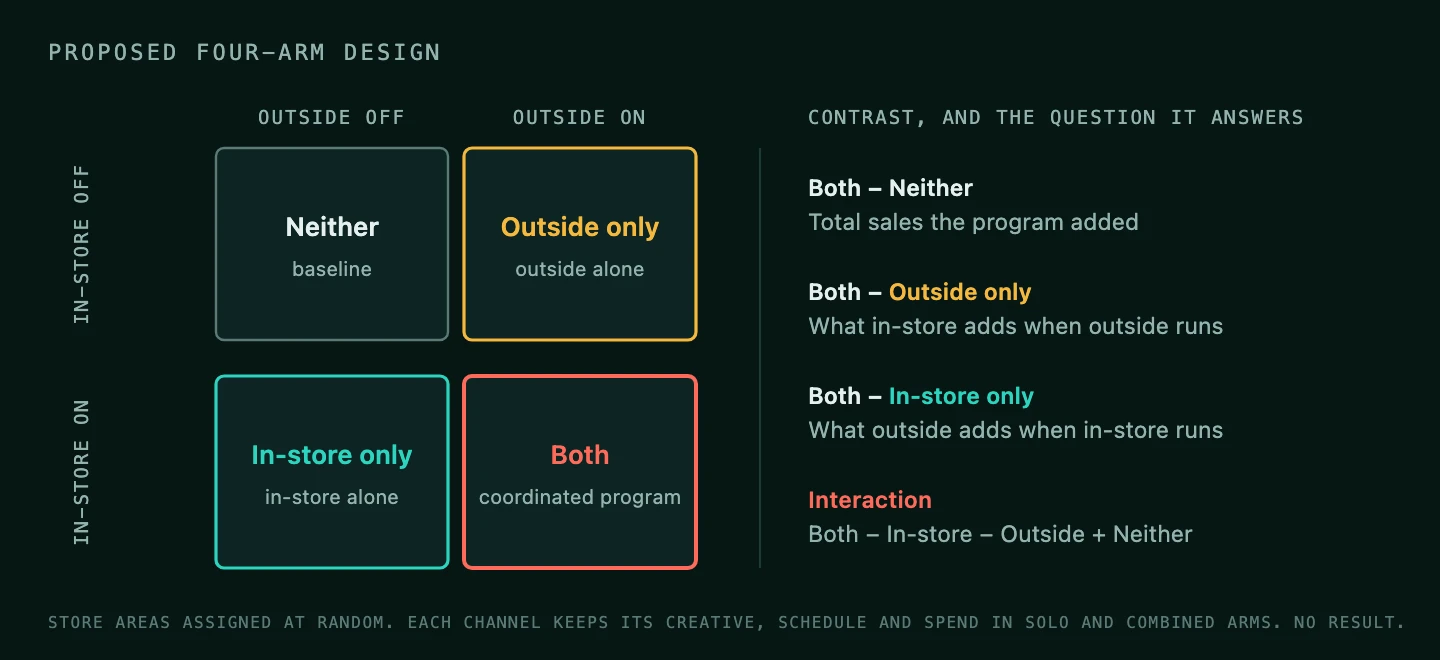
The arms spend different amounts by design, because adding a channel adds its budget. The design therefore tests this program and the effect of adding each channel. It does not test whether a fixed budget is better spent across both. To show that Occasions itself improves a plan across channels, run a separate test, powered on its own, of a context-led plan against a strong baseline at the same total budget and under the same channel limits.
A joint lift is easier to show than an interaction, and the test has to be built for the one it claims
Both channels against neither estimates the total sales the coordinated program added. Both against outside only estimates what in-store media adds when outside media is already running, and both against in-store only estimates what outside media adds. These are comparisons of groups of store areas under the design's assumptions. They do not assign any one person's purchase to a particular screen.
A combined effect larger than the sum of the parts is a harder claim. The interaction is the result with both channels, minus in-store only, minus outside only, plus neither. A positive and precise interaction supports a combined effect larger than the sum of the parts, for this program. A positive joint effect alone does not. The interaction needs its own power calculation, and an inconclusive estimate does not show it.
Before launch, the partners confirm that there are enough store areas that can be assigned independently, that both channels can be switched on and off, and that reliable sales can be read. The design allows for shoppers moving between areas and for ads reaching neighboring areas, and uses past variation to check that the test can detect an effect worth acting on. The campaign windows, the main outcome and the analysis rules are fixed before assignment. Areas are read by the arm they were assigned, with delivery failures, outages and spillover reported beside the result, and every result carries its uncertainty.
If four arms are not practical, narrow the question rather than stretch the answer. A comparison of plans at equal budget can show whether Occasions improves a plan. It cannot by itself show total lift or an interaction between channels. Each deployment needs its own check of what is practical, its own statistical design and its own operating agreement.
The supermarket study showed that a screen in an aisle works better at some moments than at others, and it stopped at the store door. The moment that matters to a shopper often starts outside the store, in a plan for dinner or a gathering at home, and the media outside can meet it there. Occasions gives the brand and the retailer one written description of that moment, by place and hour, that both sides of the door can plan from. A four-arm test, read on the retailer's own sales, then shows what the connected program added, and replication shows where the result can travel. That is the connection this paper proposes: one occasion joining the media inside the store to the media outside it, with the evidence earned in a test.

Sources, with the strength of each
Each note names the publisher, the date and the kind of evidence: peer reviewed, company statement, methodological reference, survey data or the author's own statement. Links are those of the 2026-11-13 draft of this paper; they were not rechecked for this edition.
- 1Herhausen, de Jong and Grewal, "In-Store Advertising with Digital Signage," Journal of Marketing 90(3):81-103, online 2025-06-09, issue May 2026. Randomized field experiment, peer reviewed, licensed CC BY 4.0. See the field-experimental methodology, selection effects, Tables 3 and 4, additional analyses, and limitations. The reported figure is an odds ratio, not a lift in percentage points. doi.org/10.1177/00222429251351578
- 2Nathan Woodman, LinkedIn post on the signage research and Occasions, read 2026-11-13. The author's own statement and the source of the paper's central proposition. Technical claims rest on notes 1 and 3, not on the post. linkedin.com/feed/update/urn:li:activity:7526378380083089408
- 3Herhausen, de Jong and Grewal, online supplement to the same article, 46 pages. Appendices I to L cover estimation and robustness; M covers distance between screen and product category; N to P cover spending, switching and buying earlier. The distance analysis does not move screens at random. journals.sagepub.com/doi/suppl/10.1177/00222429251351578/suppl_file/sj-pdf-1-jmx-10.1177_00222429251351578.pdf
- 4Ahold Delhaize USA, Edge launch announcement, 2026-01-07. Company statement on onsite display, sponsored search and in-store screens; not an independent study of effectiveness. No partnership is implied. adusa.com/news-releases/news-release-details/ahold-delhaize-usa-launches-edge-new-proprietary-retail-media-ad
- 5Survey data: national surveys of how people spend their day, the source of the occasion library and of the national rates by hour.
- 6Ether Data, the Occasions narrative and launch post, 2026-09-29. The check compares the served grocery occasion against observed busy times at supermarkets held out of the build. share.etherdata.ai/narrative
- 7NIST/SEMATECH, "Two-level full factorial designs," e-Handbook of Statistical Methods. Public methodological reference for factorial combinations and interaction estimates. The media test described here is Ether Data's proposed application, not a result reported by NIST. itl.nist.gov/div898/handbook/pri/section3/pri3331.htm
About Ether Data. Ether Data measures occasions, what groups of people do and where, by place and hour across the year, for media planning and measurement. It uses no device IDs. This paper is a proposal and a test design. It reports no client results, and no partnership with the research team, the retailer studied or Edge is implied.