Purpose
This knowledge base treats H3 as the canonical interchange grid, but not every input or platform is H3-native, and the generic documentation model must not silently assume properties that are true of H3 but false of the other discrete global grid systems in use elsewhere in the ecosystem. This page is the comparison matrix and the explicit statement of what must never be assumed generically across systems.
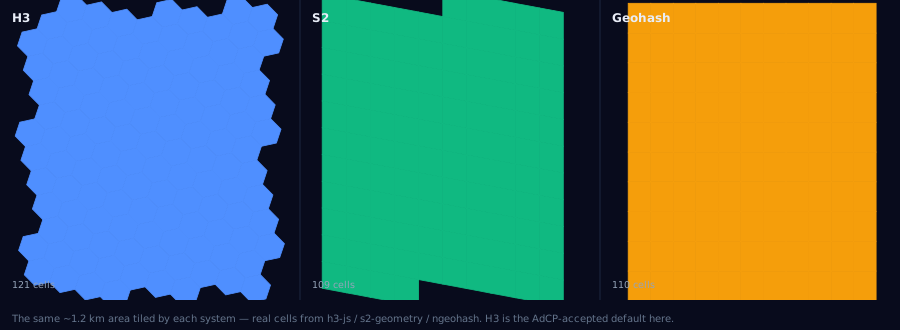
The AdCP (Ad Context Protocol) committee has accepted three cell systems as interoperable options: H3, S2, and quadkeys. This knowledge base recommends H3 as the default and treats it as the canonical interchange grid throughout; S2 and Geohash are documented here for contrast, not as alternates in active use. H3's hexagonal cells give every non-pentagon cell a uniform distance to its six neighbours and compact well into multi- resolution sets, which is why H3 rather than a quadrilateral or rectangular scheme is the standard.
Comparison matrix
| Dimension | H3 | S2 | Geohash |
|---|---|---|---|
| Cell shape | Hexagon (mostly), 12 pentagons per resolution | Quadrilateral | Rectangle |
| Hierarchy model | Aperture-7; each parent has approximately 7 children | Quad; each parent has exactly 4 children | Base-32 prefix; each level adds 32x subdivision |
| Children per parent | ~7 (not exact by area) | Exactly 4 | 32 |
| Equal-area | Approximate (varies ~2x globally) | No | No (shrinks toward poles) |
| Exact parent-child geometric containment | No — logical index arithmetic, children can spill past parent boundary | Yes — 4 children exactly tile the parent | Yes — prefix relationship is an exact containment |
| Global coverage | Yes | Yes | Yes |
| Index representation | 64-bit index, hex string | 64-bit cell id (Hilbert curve position) | Base-32 string |
| Compaction support | Yes (compactCells/uncompactCells) | Yes | No |
| Key caveats | 12 pentagons/resolution; face-crossing distortion; ~2x area variance | Not equal-area; 4 or more neighbours depending on position | Not equal-area; alternating aspect ratio; antimeridian/edge discontinuity between adjacent prefixes |
What the generic model must not assume
Every one of these is true of H3 specifically and false of at least one other system in this table. Code, prose, or a schema field that encodes any of these as a general "cell system" property rather than an H3-specific one is a latent bug the first time a non-H3 system reaches it.
- Hexagons
- Only H3 has hexagon-dominant cells, and even H3 is not all-hexagon. S2 is quadrilateral, Geohash is rectangular.
- Six neighbours
- True only for non-pentagon H3 cells. S2 cells have 4 edge neighbours (more at corners); Geohash rectangles have 4.
- Uniform cell shape
- H3 mixes hexagons and pentagons; the other two systems are each uniform in shape, but that shape differs system to system — 'uniform' does not imply 'hexagon.'
- H3 resolution numbering
- H3's 0-15 scale, its aperture-7 area ratio per level, and its pentagon count per level are H3-specific. S2's 0-30 levels and Geohash's 1-12 character lengths are independent, with no direct level-to-level equivalence.
- Identical hierarchy semantics
- 'Hierarchical' does not imply the same containment guarantee. S2 and Geohash give exact geometric/prefix containment; H3 gives logical-only containment.
- Exact parent-child containment
- Only S2 (exact quad tiling) and Geohash (exact prefix containment) guarantee this. H3 explicitly does not — treating an H3 parent-child relationship as exact containment is a documented source of silent boundary error.
Cross-system conversion has no direct cell-to-cell map
There is no lookup table mapping an H3 cell index directly to an S2 or Geohash index, because the three systems tile the sphere with different geometries at different resolutions — no cell boundary in one aligns exactly with any boundary in another. The only correct conversion path is geometric, not index-based:
- Extract each source cell's true boundary polygon in the source system
(
cellToBoundaryor the equivalent for S2/Geohash). - Union the boundary polygons into a single region (or multipolygon, with antimeridian handling per antimeridian-handling if applicable).
- Re-fill that region into the destination system using the destination
system's own polyfill operation and containment mode (
center,full,intersect, or the destination system's equivalent).
This path necessarily introduces the same containment-mode approximation
error documented throughout the source-to-H3 conversion pages, applied a
second time if round-tripping — a cell set converted H3 to S2 and back is
not guaranteed to reproduce the original exactly, and the discrepancy
should be measured with coverage_ratio and jaccard, not assumed zero.
Resolution behavior across systems
Because the three numbering systems are independent, "matching resolution" across systems requires an explicit area-based correspondence (choosing the H3 resolution, S2 level, and Geohash length whose typical cell areas are closest) rather than assuming numeric equivalence — an H3 resolution 7 cell and an S2 level 13 cell are not defined to correspond by their numbering; any correspondence used here is an approximate area-match stated explicitly, not a system property.
Quality metrics
coverage_ratio, overreach_ratio, underreach_ratio, and jaccard
computed on the re-filled destination cell set against the union polygon
produced in step 2 above — the standard metrics apply unchanged across
systems since they are defined on areas, not on index arithmetic.
Edge cases
pentagons affects H3 (12 per resolution) and requires per-cell shape
handling rather than a hexagon-derived constant. mixed-resolutions
applies within any single system's own hierarchy (see
mixed-h3-resolutions) and is a distinct
concern from cross-system resolution correspondence discussed above —
do not conflate mixing resolutions within H3 with matching resolutions
across systems.
References
- H3 — Uber, h3geo.org
- S2 Geometry — Google, s2geometry.io
Assumptions and limitations
The matrix above reflects the generic system models registered in
data/cell-systems.yaml as of this page's review date; exact resolution
ranges, compaction support, and containment guarantees should be
re-verified against each system's current documentation before relying on
them for a production decision.
Illustration — hexagon vs pentagon shape
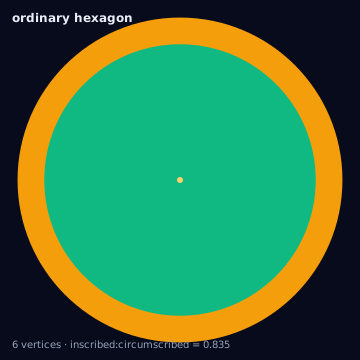
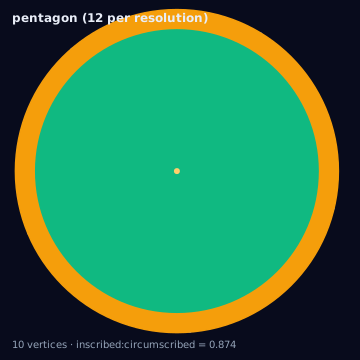
The inner (green) and outer (amber) circles show each cell is only approximately regular; the pentagon's boundary carries extra vertices where it crosses an icosahedron edge.
Illustration — the same area, three systems